The Dispatch
TRUST IN DATING PLATFORMS COLLAPSES; CATFISH POPULATION MEANWHILE THRIVING
Barely one in ten daters believes the apps police their own waters; the FTC counts the cost in the billions
LISBON, PORTUGAL — This paper regrets to report that the waters are not safe, and the harbormasters know it. Per Pew Research, only about one in ten online daters believes the companies do a very good job removing fake accounts. Roughly the same for removing abusive users. The citizens, in short, have surveyed the harbor patrol and concluded the harbor patrol is asleep.
The citizens are not paranoid. Consumer surveys find nearly four in ten daters report having been catfished — courted by a person who was, upon inspection, a different person, or several people, or no person at all. And the stakes now run far past embarrassment: the Federal Trade Commission tallied romance-scam losses at over a billion dollars in a single recent year, with regulators separately warning of "relationship investment" schemes — the long con that begins with pet names and ends with a cryptocurrency wallet.
Note the progression, dear reader: what began as a lonely-hearts nuisance is now a matter of congressional attention, with proposed legislation that would require dating services to notify users who corresponded with accounts later banned for fraud. When Congress starts drafting your feature roadmap, the industry has, in this paper's opinion, missed a memo.
Why do the fakes flourish? Because the standard architecture is a paradise for them: anonymous entry, zero declared intent, and open-ended chat — the precise habitat in which a patient fraud operates. Ambiguity is not only exhausting for the honest; it is camouflage for the dishonest.
MOOD was drafted for the after-the-memo era: verification built into the platform's bones, declared intent that strips away the fog a scammer hides in, and structured first contact that gives the long con nowhere to sprawl. A fraud needs an ocean of vague conversation. We are draining it on purpose.
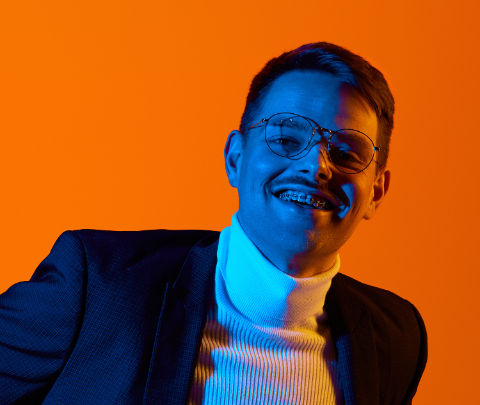
A gentleman who is, upon inspection, exactly who he says he is — a rarity the Harbor Patrol wishes to encourage.
From the Screenshot Museum
Exhibit 09-A. A courtship, days one through eleven. Annotated by the Fraud Desk.
DAY 1: Hello dear. Your smile is like sunshine of the morning.
DAY 3: I am surgeon working on oil rig. It is lonely here but you make it warm.
DAY 6: I feel we have connection deeper than the others. Do you believe in destiny, my dear?
DAY 9: My dear, a strange thing. My bank has frozen my account due to maritime regulations.
DAY 11: It is small thing. Only gift cards. For the maritime regulations.
Curator's note: There is no surgeon. There is no rig. There are, tragically, always the gift cards.
The Burnout Diaries
Entry submitted by P., 41, accountant.
Day 29. Tonight I reverse-image-searched a man's photos before replying to him. This is normal now. I ran a background check on a stranger like I'm hiring a nanny, because the last "great guy" turned out to be using pictures of a fitness influencer from Portugal. I found out because I recognized the influencer. From a previous catfish. The same Portuguese man is unknowingly dating half of Texas. I don't even feel betrayed anymore, just... administrative. Dating apps turned me into a one-woman compliance department. I do audits all day. I did not want to do them at dinner.
Reprinted with permission, spelling intact. Submit your own to [email protected].